Why AI Changes the Equation
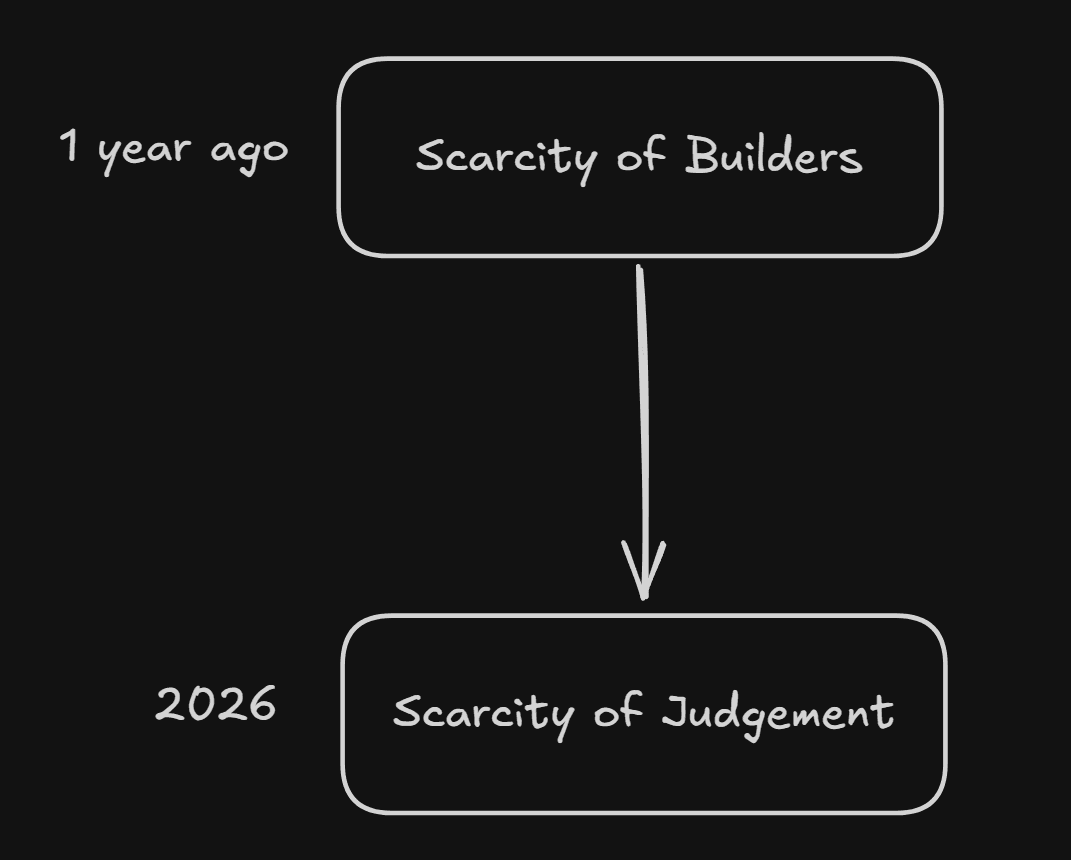
The bottleneck has shifted from building things to deciding what is worth building and ensuring it is coherent, simple, and aligned with real needs. I think leverage belongs to those who can frame problems clearly, exercise judgment under uncertainty, and take responsibility for outcomes.

Wearing All Three Hats
I do not treat design, engineering, and product as separate phases. I move between them continuously to reduce risk and increase clarity.
In 2026, people who wear all three hats, Designer, Engineer, and Product Manager, are high-bandwidth orchestrators of intelligence.
As a Product Manager
Product management is not backlog grooming. It is structured decision-making under ambiguity.
The role sits at the intersection of user value, business value, and technical reality. My responsibility is to reconcile those forces and turn them into coherent direction.
The Core Questions
- What problem are users actually facing?
- Why does solving it matter to the business?
- Is the solution feasible given our technical constraints?
- What tradeoffs are we making?
The Roadmap Is a Living Argument
I don’t treat the roadmap as authority handed down. It’s a living argument — a constantly evolving hypothesis about where value lies.
The best ideas win. Not the loudest ones.
Prioritization Is Multi-Dimensional
Prioritization isn’t just feature value. It includes technical debt, effort, platform dependencies, organizational alignment, and long-term architectural direction.
Sometimes the highest-leverage move is not a feature — it’s infrastructure.
Data, Then Dialogue
Behavioral and performance analytics are essential. They tell you what is happening.
But data alone is insufficient. It raises questions that only users can answer.
That’s why I conduct direct interviews — to uncover the “why” behind the behavior.
My Focus
- Extract the real problem.
- Translate it into a clear narrative.
- Align the team around that narrative.
- Continuously adjust as new information emerges.
Product management, at its best, is clarity creation.
As a Designer
Design begins with building accurate mental models of users. I translate those models into clear personas — written representations of who we are serving and how they think.
Designers study what users actually do, not what we assume they do. Research, analytics, interviews, usability testing, and journey mapping inform how behavior unfolds in the real world.
Reframing the Problem
One of the most important design skills is reframing problem statements. Teams often jump prematurely to solutions. Designers slow that down and ask:
- What problem are we truly solving?
- Which personas are affected?
- What unintended consequences might emerge?
Persona awareness is protection against narrow thinking.
Sitting Between Vision and Reality
Designers sit between product managers and engineers. We co-own the “what” with product. We shape workflows, interactions, and interfaces.
We receive constraint insight from engineers — technical effort, architectural limits, state management realities — and translate research and product goals into practical interaction decisions.
System-Level Thinking
Mature design is not screen-level decoration. It considers data flow, state management, and how systems behave over time.
Designers who think in abstractions — reusable components, pattern libraries, and scalable systems — create exponential leverage.
The Human Edge
In the age of AI, execution is increasingly commoditized. Empathy is not.
Design may be the most important role in an AI-native world — because it guards the human experience.
As an Engineer
Engineering is the discipline of making reality coherent.
My responsibility is to ensure that changes to the system — wherever they occur — remain compatible, stable, and sustainable.
Partnering Early
I partner with product and design to review user stories and proposed designs for feasibility, risk, resource constraints, and missing implementation detail.
Engineers should help shape scope — not just receive it.
Building for Integrity
- Implement with reuse and reduction in mind (DRY).
- Prefer deletion over unnecessary complexity.
- Write unit tests to protect local correctness.
- Write end-to-end tests to protect system-level behavior.
End-to-end tests guard integrations, data flows, and performance in real deployed environments. Deployments should not ship broken contracts.
Knowing When Not to Optimize
Engineers can spot designs that are too complex for an MVP. We understand the true cost of abstraction and optimization.
Sometimes the highest-leverage move is simplification.
Understanding System Hierarchy
Not all functions are equal.
- Core functions that must not fail.
- Functions whose failure degrades experience.
- Functions that can fail safely without cascading impact.
This hierarchy informs test strategy, monitoring, and operational investment.
Infrastructure Ownership
Engineers own CI/CD pipelines, shared libraries, internal documentation, and reference implementations.
These systems determine how safely and quickly a team can evolve.
External Awareness
I build deep understanding of external services: APIs, integrations, data contracts, timing characteristics, and system dependencies.
Strong engineering requires awareness beyond the local codebase.